



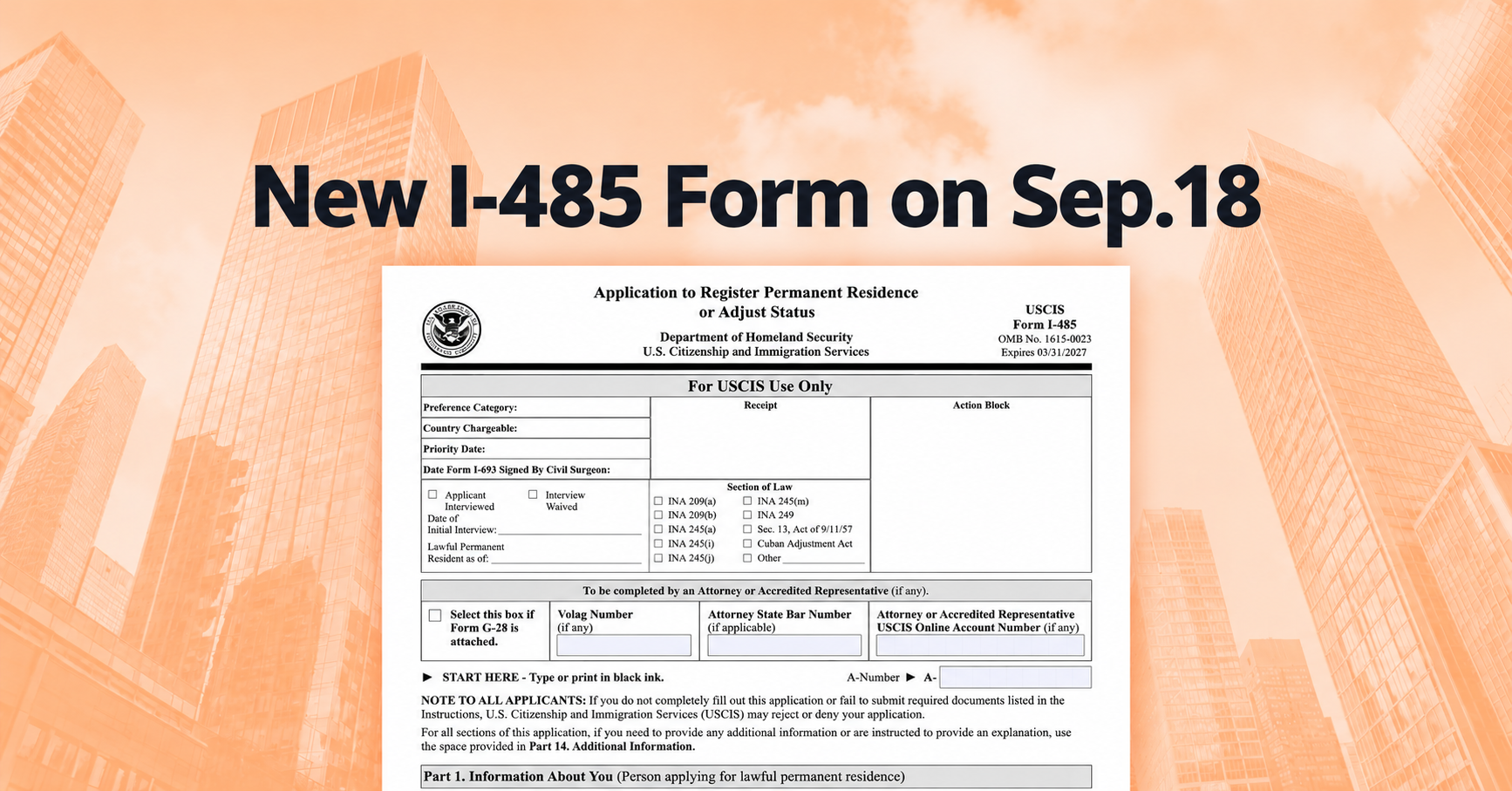
USCIS Is Replacing Form I-485 on September 18, and There’s No Grace Period


If you plan to file for adjustment of status, the edition date on your Form I-485 now matters as much as the contents. USCIS has published a revised Form I-485 (edition 09/18/26) to implement the new public charge rule, and the transition is unusually sharp: applications postmarked or submitted on or after September 18, 2026 must use the new edition, and the new edition cannot be filed before that date. There is no overlap window. File the old form a day late, or the new form a day early, and the package comes back rejected, with whatever priority, status, or child-age consequences a rejected filing carries for your case.
By Origin Law P.C. | August 24, 2026
What changed, and why
The revision implements the Public Charge Ground of Inadmissibility final rule published in July 2026 and effective the same September 18 date. Rather than reviving the separate financial-disclosure form used under the 2019-era framework, USCIS folded expanded public charge questions directly into the I-485. Covering household finances, health insurance, and benefits history in more depth than the outgoing edition. The substantive standard behind those questions changes on the same day; our companion analysis of the 2026 public charge rule covers what adjudicators will now consider.
The timing decision every applicant should make deliberately
The hard cutover creates a genuine strategic question for anyone whose adjustment filing is close to ready:
Filing before September 18 means the current (01/20/25) edition and adjudication under the transitional benefits framework, where only public cash assistance for income maintenance and long-term institutionalization count against an applicant. For applicants who are otherwise ready. Medical exams valid, priority date current, documents assembled. Completing the filing under the existing framework is worth an honest sprint.
Filing on or after September 18 means the new edition, the expanded questions, and the broader benefits inquiry. That is not a reason for panic. The test remains a totality-of-circumstances judgment, and a well-documented filing addresses it, but it is a reason to prepare the financial record to a higher standard: assets, insurance, household size, and any benefits history, documented and explained rather than left to inference.
For our EB-5 investor clients, this lands directly on concurrent-filing strategy: an I-526E investor whose adjustment package can be completed in the next three weeks has a real timing incentive; one who can’t should plan the stronger financial exhibit set from the start. For employment-based applicants waiting on a current priority date, the choice may be made for you, but the preparation standard shouldn’t be.
Practical checklist
Confirm the edition date on the form the day you print it, not the day you started drafting. Packages assembled over weeks are exactly the ones that go out with a stale edition. Calendar September 18 twice: as the last-mailing deadline for old-edition filings (postmark controls) and as the first-permissible date for new-edition filings. If a filing will straddle the date, prepare it on the new edition and hold it. And treat the medical exam’s validity window and the visa bulletin as part of the same calculation. A rejected package that must be refiled after a retrogression can cost far more than the paperwork.
Frequently asked questions
My application is already pending. Does the new form affect me? No. The edition requirement applies to new filings. The substantive public charge standard applied to pending cases follows USCIS’s implementation guidance; filings made before September 18 are evaluated under the transitional framework described in the agency’s August guidance.
Can I file the new edition early to get ahead of the change? No. USCIS has said expressly not to file the 09/18/26 edition before September 18. Early filings on the new edition are rejected just as late filings on the old one are.
Does a rejected package lose my place in line? A rejection means no filing occurred, which can matter enormously if a visa category retrogresses, a child’s age calculation depends on the filing date, or status expires in the gap. Edition-date compliance is low-effort insurance against high-cost consequences.
Where do the new public charge questions come from? From the July 2026 final rule, effective September 18, which rescinds the 2022 framework and broadens what officers may consider. See our full analysis of the 2026 public charge rule for what that means in practice.
Attorney advertising; general information, not legal advice.